
Profound vs Scrunch AI. An honest comparison.
Which one is right for your team — and what you’ll actually hold in your hands after a month with each.

Free 30-minute strategy call with Meet.
The deepest data in the category. Priced and sold like enterprise software — because it is.
Self-serve, transparent, and architecturally the most interesting. Now a Sitecore product.
Both tell you where you’re losing in AI answers. Neither writes what wins. More on that below.
Two trajectories, one category.
Both founded within three years. Both rated 4.6/5 on G2. Then 2026 split them: Profound raised its way to a $1B valuation. Scrunch sold.
“The full stack marketing platform for AI search” — answer engine insights, demand data, and agent analytics for enterprise brands.
- Founded
- 2024 — New York City
- Funding
- ~$155M raised; $96M Series C (Feb 2026) at a $1B valuation
- Customers
- 700+ enterprises, including roughly 10% of the Fortune 500
- Named logos
- Target, Walmart, Figma, MongoDB, US Bank, Ramp
- G2 rating
- 4.6/5 across 100+ reviews; G2 Winter 2026 AEO Leader
“The AI customer experience platform” — visibility monitoring, persona-based journeys, and an AI-readable mirror of your site served to crawlers.
- Founded
- 2023 — Salt Lake City
- Funding
- ~$26M raised; acquired by Sitecore in June 2026 (reported ~$225M)
- Customers
- 500+ brands
- Named logos
- Lenovo, SKIMS, Penn State, Crunchbase, Runpod
- G2 rating
- 4.6/5 across 50+ reviews
Read this before any older comparison.
Most Profound-vs-Scrunch articles were written in 2025 and are now materially out of date. Two events this year changed the calculus.
Led by Lightspeed. Roughly $155M raised in under two years. The round funds a push beyond measurement — an Agents execution layer, Profound Sheets, deeper enterprise. Profound is now the category’s default incumbent, with the pricing power that implies.
Announced June 3, 2026. Founder Chris Andrew stays on as division CEO; Scrunch folds into the SitecoreAI platform. For Sitecore customers, a clear win. For everyone else, open questions — roadmap priority, pricing continuity, and whether Scrunch stays a product or becomes a DXP feature.
Feature by feature.
| Core focus | Enterprise AI search intelligence — visibility, demand data, citations, agent analytics. | AI visibility plus a delivery layer that serves AI-readable versions of your site to crawlers. |
|---|---|---|
| AI platforms monitored | ChatGPT, Perplexity, Claude, Gemini, Google AI Overviews, Copilot, Grok, Meta AI, DeepSeek. | ChatGPT, Claude, Gemini, Perplexity, Google AI Mode & AI Overviews, Copilot, Meta AI, Grok.Full platform list has historically been gated to Enterprise. |
| Demand data | Prompt Volumes — AI query demand estimated from a consumer panel Profound says covers 400M+ real conversations.Unique in the category; practitioners debate how verifiable the estimates are. | AI Search Trends — prompt volumes across 1,500+ curated topics.Reviewers describe topic coverage as thinner. |
| Methodology | Scheduled prompt runs across engines, layered with panel data and citation analysis at scale. | Prompt runs segmented by persona (3–5 by plan), topic, model, and region; share-of-answer and position scoring. |
| Hallucination detection | Sentiment and misrepresentation surfaced within answer insights. | Dedicated hallucination detection that flags false claims about your brand.Enterprise plans only. |
| Bot & agent analytics | Agent Analytics — AI crawler activity and AI-referred traffic.Reviewers note it reports page categories, not exact URLs. | Real-time AI crawl feed (GPTBot, ClaudeBot, PerplexityBot) plus LLM referral traffic with GA4 integration. |
| Action layer | Agents — template-based workers (FAQ generation, content refresh) that can publish to your CMS behind a human approval step.Launched recently; third-party reviews still describe it as nascent. | Agent Experience Platform (AXP) — serves a restructured, token-light mirror of existing pages to AI crawlers at the CDN layer.Transforms what you already published; does not create new pages. |
| Net-new content | Early, template-driven, approval-gated. | No — recommendations and page audits only. |
| Entry price | No public self-serve pricing. Reviewers report roughly $499/mo entry, with custom enterprise pricing for full coverage. | $250/mo billed annually ($300 monthly) for Starter; Growth $417/mo annually; Enterprise custom. |
| Free trial | No — demo-led sales process. | 7-day free trial, no credit card. |
| Security & compliance | SOC 2 Type II, HIPAA, SSO/SAML, dedicated account teams. | SOC 2 Type II, SAML/OIDC SSO, RBAC, multi-site and multi-region support. |
| Best fit | Enterprise and regulated brands with global footprints and budget for a sales-led platform. | Mid-market teams and agencies that want to start fast — now operating inside Sitecore. |
Compiled June 2026 from both companies’ public sites and pricing pages, G2 reviews, and third-party platform reviews. Profound’s pricing is not published; figures are as reported by reviewers and may vary by contract. No affiliate links. No sponsored placements.
After 30 days, here’s what you’re holding.
Forget the feature names. This is what actually lands on your desk a month in.
- A visibility benchmark across nine AI engines — you vs every competitor, refreshed continuously.
- A prompt list ranked by estimated real-world demand, not by what your team guessed people ask.
- An “Opportunities” queue your content team can pull from, plus crawler analytics on what AI bots read.
- Agent drafts waiting in an approval queue — if your contract includes them.
- Share-of-answer scores split by persona, region, and engine — how a CFO vs a developer sees you.
- Page audits with named gaps: missing claims, pricing, specs, and flat-out wrong AI statements.
- Once AXP is configured, AI crawlers read clean, token-light mirrors of your key pages.
- GA4 reports showing which AI engines actually send you traffic.
What neither hands you: the published page. Both backlogs end at “someone should write this.”
What the data gets you.
Strip the marketing and both platforms share an engine: run prompts on a schedule, record the answers, score your presence. The difference is the layer on top.
- Prompt Volumes weights every prompt by estimated real-world conversation volume.
- Built on a consumer panel Profound says covers 400M+ real conversations.
- Nobody else has it. Prioritization stops being a guess.
The catch: practitioners question whether anyone can verify panel-based volume estimates. Directional, not gospel.
- Prompts run per buyer persona and region.
- A CFO reads different answers than a developer. Scrunch shows you both.
- More decision-shaped. Also narrower.
The catch: credits historically burned per engine — 125 prompts across 4 engines meant ~31 real queries. The 2026 tiers raised limits; check the math anyway.
Each vendor attacks the other’s methodology. Profound calls rival prompt sets “synthetic.” Scrunch notes Profound can’t deliver content to crawlers. Both critiques are self-interested. Both contain some truth.
What happens after the dashboard.
This is the real fork in the comparison — and where most write-ups go shallow.
- Template workers for FAQ generation, content refreshes, competitive research.
- Can publish to your CMS — behind a human approval step.
- Launched recently. Reviewers still call it nascent.
- Templates produce what templates produce.
Evaluating Profound? Ask to see Agents live on your own site — not the slide.
- Detects AI crawlers at the CDN. Serves them a machine-readable mirror of each page.
- ~124,000 tokens → ~1,255. The same pricing page, re-served.
- The most architecturally interesting feature in the category.
The debate: competitors say serving bots different content flirts with cloaking. Scrunch says Google and Bing see the normal site. Make your own call.
Profound’s Agents fill templates. Scrunch’s AXP reformats what exists. The article that doesn’t exist yet — stays not existing.
Pricing and the buying experience.
Same category. Opposite go-to-market. This is the clearest difference between the two — and the easiest way to disqualify one of them today.
- No trial. No self-serve. Every deal starts with a call.
- Reviewers report ~$499/mo entry; the real platform lives in custom enterprise contracts.
- G2’s steadiest complaint: the feature you want is on the plan you didn’t buy.
- Up there, it’s strong: SOC 2 Type II, HIPAA, unlimited view-only seats, a dedicated AI search strategist.
- 7-day trial. No card. Published pricing.
- Starter $250/mo (annual) — a marketing manager can expense it.
- The differentiators — hallucination detection, all nine engines, the API — are Enterprise-only.
- Post-acquisition, assume packaging follows Sitecore’s roadmap.
Pick by team, not by feature list.
Pick Profound if…
- You’re an enterprise or regulated brand — HIPAA, SOC 2, SSO, and procurement are requirements, not nice-to-haves.
- Demand data matters — Prompt Volumes is the only way to weight AI prompts by estimated real-world volume.
- You have the budget and patience for a sales-led motion and a platform with a real learning curve.
- You want the category incumbent — the most reviews, the most funding, the most enterprise logos.
Skip it if you’re a lean team without enterprise budget. The entry tier is deliberately limited, and the platform is built — and priced — over your head.
Pick Scrunch if…
- You’re mid-market or an agency and want visibility data running this week, on a card, with a trial.
- AXP fits your stack — you want AI crawlers served clean, structured versions of pages you’ve already built.
- Persona-level views map to how your marketing team actually thinks about buyers.
- You’re a Sitecore customer — the acquisition makes Scrunch the path of least resistance inside that ecosystem.
Skip it if you need heavy reporting and exports, full engine coverage on a starter budget, or roadmap certainty — post-acquisition, those calls belong to Sitecore.
Both answer “where are we losing?” Neither answers “who ships the fix?”
Run either platform for a month. You’ll end up with the same artifact: a list of prompts where competitors get recommended and you don’t.
The dashboard’s job ends there.
Someone still has to research the gap. Write the page that deserves the citation. Publish it. Check whether the answer moved.
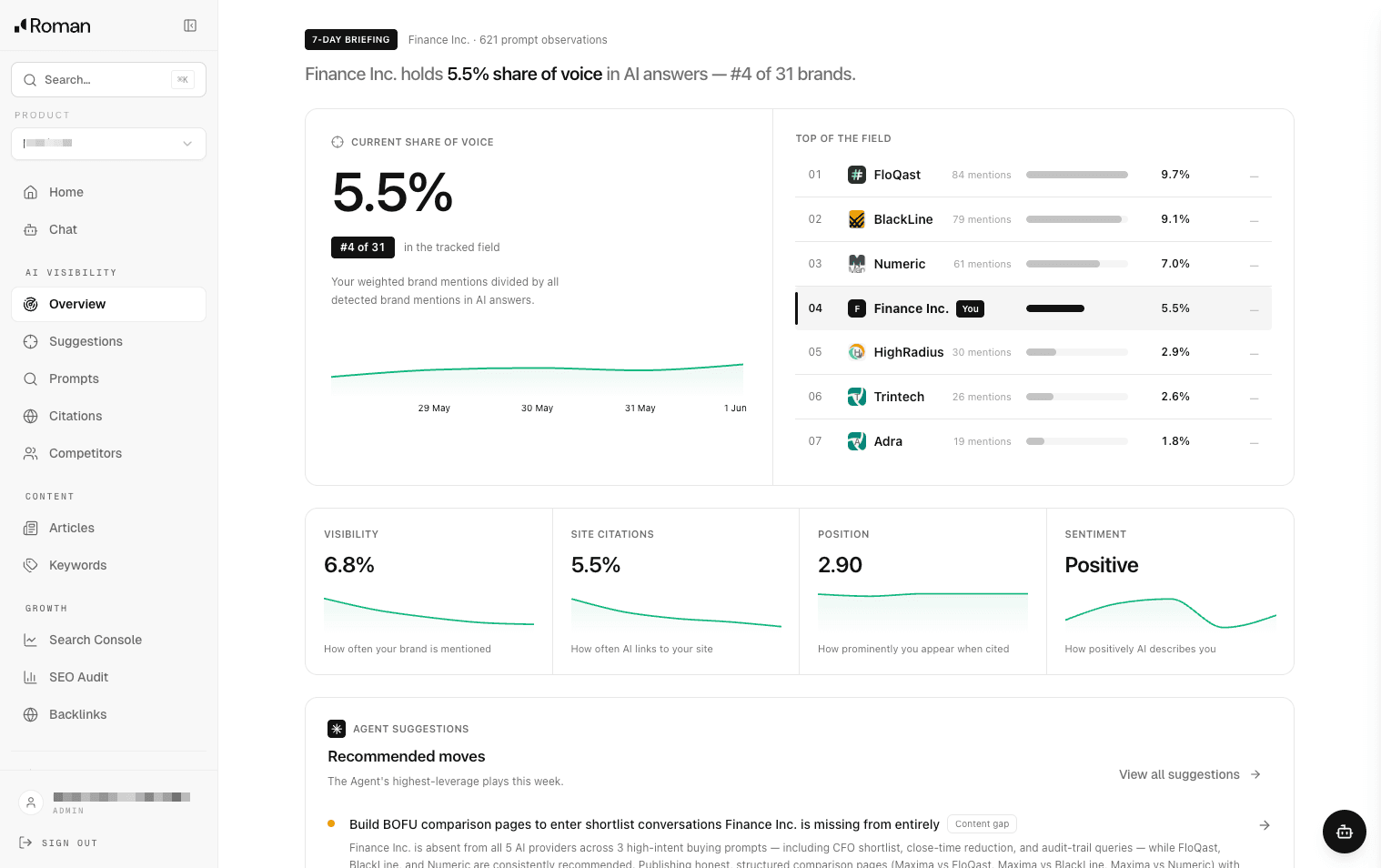
That’s the part we build. Roman tracks the same engines — then its agents research, write, publish, and re-measure. We start where measurement stops.
Is Profound or Scrunch AI better?
Neither is universally better — they sit at different ends of the same market. Profound has the deepest data in the category (including Prompt Volumes, its consumer-panel demand data) and the strongest enterprise credentials, but it is sales-led and priced accordingly. Scrunch is faster to start, self-serve, and ships a genuinely unique delivery layer (AXP) that serves AI-readable versions of your pages to crawlers.
A reasonable shorthand: Fortune 500 brand with budget and procurement — Profound. Mid-market team that wants visibility data this week — Scrunch.
How much does Profound cost?
Profound does not publish self-serve pricing. Third-party reviews report an entry point around $499/month, with the features most teams actually want — multi-platform coverage, Prompt Volumes, API access — gated to custom-priced enterprise plans. Every purchase starts with a sales call, and there is no free trial.
How much does Scrunch AI cost?
Scrunch publishes its pricing: Starter at $250/month billed annually ($300 monthly) with 350 custom prompts and 3 personas, Growth at $417/month annually with 700 prompts and 5 personas, and custom Enterprise plans that add SAML/OIDC, the data API, and expanded limits. There is a 7-day free trial with no credit card required.
Did Sitecore acquire Scrunch AI?
Yes. Sitecore announced its acquisition of Scrunch on June 3, 2026 — Bloomberg reported the price at roughly $225 million. Founder and CEO Chris Andrew is staying on to run the division, and Scrunch is being combined with the SitecoreAI digital experience platform. What that means for Scrunch as a standalone product is still an open question.
Do Profound or Scrunch write and publish content?
Mostly no. Both are measurement-first platforms. Profound launched an execution layer called Agents — template-based workers that can draft FAQ updates and content refreshes and publish to a CMS behind a human approval step — but third-party reviews still describe it as early. Scrunch does not create content at all: its AXP restructures pages you already published so AI crawlers can read them, and everything else is recommendations.
Closing the gap from "we are invisible for this prompt" to "a page now exists that wins it" is a different job — and it is the job Roman was built for.
What is Scrunch AI’s Agent Experience Platform (AXP)?
AXP detects AI crawler traffic at the CDN layer (Akamai, Cloudflare, Vercel) and serves it a parallel, machine-readable version of each page — server-rendered, structured, and dramatically lighter in tokens. Human visitors and traditional search crawlers see your normal site.
It is Scrunch’s clearest differentiator, and also its most debated feature: competitors argue that serving different content to bots and humans carries cloaking risk. Scrunch maintains that traditional crawlers are unaffected.
What is Profound’s Prompt Volumes?
Prompt Volumes estimates how often topics actually come up in AI conversations, built on what Profound describes as a panel of 400M+ real, double-opt-in user conversations. No competitor has an equivalent, which makes it Profound’s most cited advantage — though some practitioners question whether prompt-volume estimates can be independently verified.
Are there alternatives to Profound and Scrunch?
The AI visibility category is crowded — Ahrefs Brand Radar, Semrush AI toolkit, Peec, Otterly, and others all track AI answers. The bigger question is what happens after measurement. If your bottleneck is not knowing where you stand, any strong tracker works. If your bottleneck is shipping the content that changes the answer, look at Roman — it tracks the same engines and then researches, writes, and publishes the pages that close the gaps it finds.
Researched June 2026 from tryprofound.com and scrunch.com (product and pricing pages), G2 reviews of both platforms, Fortune’s coverage of Profound’s Series C, and Sitecore’s acquisition announcement with Bloomberg’s reported deal terms. Both platforms ship fast — if something here is out of date, we’ll fix it.
Tracking tells you the gap. Roman closes it.
See where AI recommends your competitors — then watch the content that changes the answer get researched, written, and shipped.