Deliverables on your desk, not features on a pricing page.
02
Real entry price
What it actually costs to start — including the add-on math.
03
Engines covered
ChatGPT alone isn’t coverage. Claude and AI Overviews count.
04
Beyond measurement
Does anything get fixed, written, or shipped — or just charted?
At a glance
The list in one table.
#
Tool
Best for
Entry price
Trial
01
Roman
Closing the loop
from $199/mo
articles included
02
Profound
Enterprise depth
~$499/mo reported entry
no trial
03
Scrunch AI
Mid-market teams
$250/mo annual
7-day trial
04
Peec AI
Agencies & EU teams
~€90/mo reported
unlimited seats
05
Otterly.AI
Budget entry
$29/mo
free trial
06
Ahrefs Brand Radar
SEO teams on Ahrefs
~$828/mo all-in
needs Ahrefs sub
07
Semrush AI Toolkit
All-in-one suites
$99/mo
7-day trial on bundles
08
AthenaHQ
Action workflows
~$270/mo reported
no trial
09
Adobe LLM Optimizer
Adobe enterprises
~$115K/yr est.
sales only
Compiled June 2026 from vendor pricing pages, G2/OMR reviews, and press coverage. Where vendors hide pricing, figures are as reported by reviewers. No affiliate links anywhere on this page.
01
Roman
Best for closing the loopThis is us
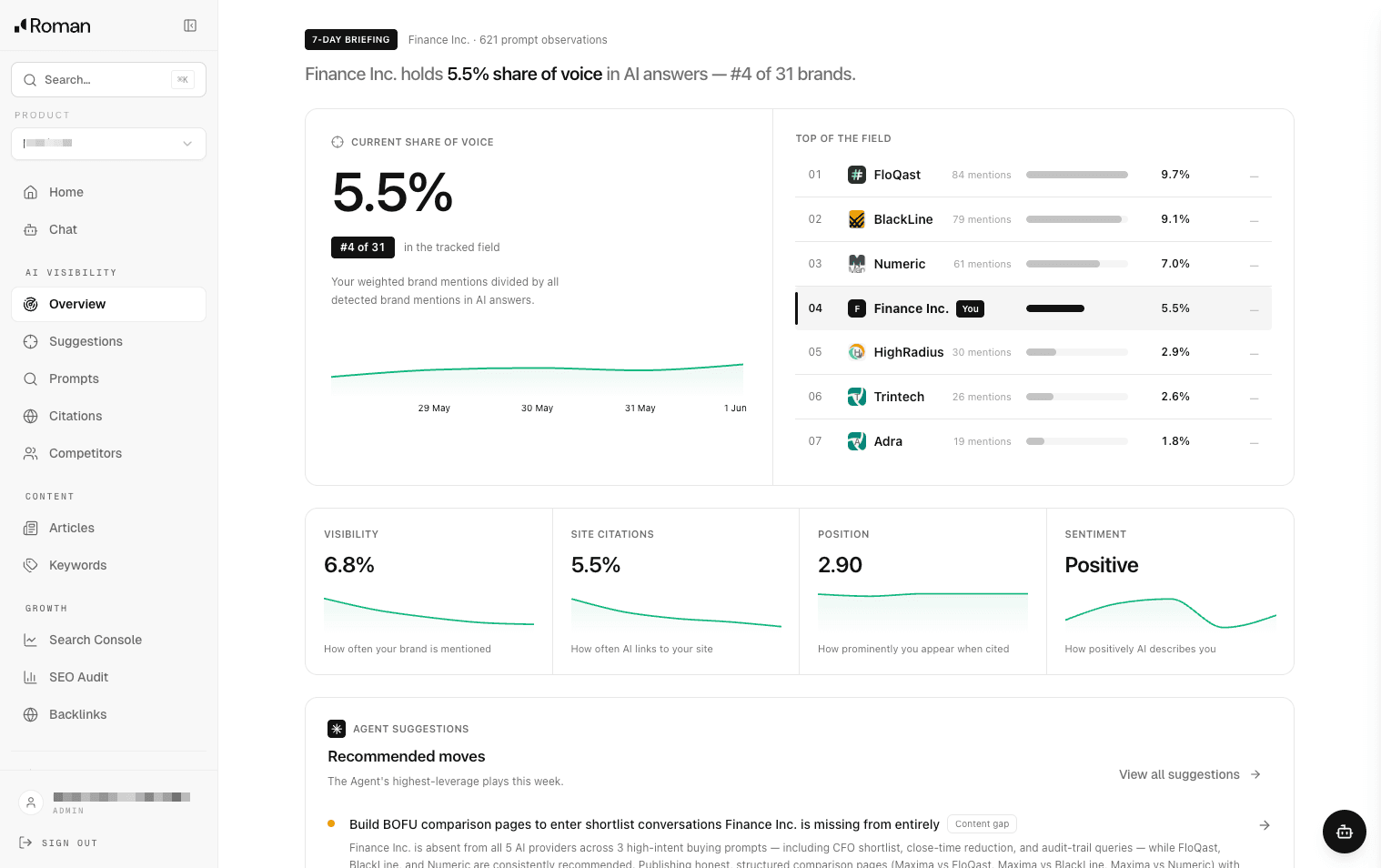
Every other tool on this list hands you a list of prompts you’re losing. Roman is the only one whose agents then research, write, and publish the content that wins them — and re-measure once it ships.
Tracks ChatGPT, Gemini, Perplexity, and Google AI Overviews by plan, with Claude available as a per-product add-on — and prompts sourced from real audience signals like Search Console queries and Reddit, not just generated guesses.
Every gap becomes a queued action: new article, page refresh, comparison page, or citation play — drafted and published to your CMS.
Articles are built on your product, positioning, and internal insight — content only you could publish, not template output.
Pricing includes the writing: $199/mo covers 20 articles a month; $499/mo covers 75 articles, 100 AI-visibility prompts, and four bundled engines. Claude is available as a per-product add-on.
Skip it if you only want dashboards. If nobody intends to act on the gaps, a pure tracker further down this list costs less.
from $199/mo · Claude add-on · articles included
02
Profound
Best for enterprise depth
The category incumbent — a $1B valuation, 700+ enterprise customers, and the deepest dataset in the field. If budget isn’t the constraint, this is the data everyone else benchmarks against.
Prompt Volumes estimates real-world AI query demand from a panel Profound says covers 400M+ conversations — no competitor has an equivalent.
Widest engine net here: nine platforms, including Grok, Meta AI, and DeepSeek.
Enterprise trust by default: SOC 2 Type II, HIPAA, SSO, and a dedicated AI search strategist on top plans.
Skip it if you’re a lean team. No trial, sales-led only, and reviewers report the features you actually want live in custom enterprise contracts.
~$499/mo reported entry · 9 engines · no trial
Screenshot — Profound · Answer Engine Insights
03
Scrunch AI
Best for mid-market teams
The fastest credible start in the category — published pricing, a 7-day trial, and AXP, a delivery layer that serves clean, token-light versions of your pages to AI crawlers. Acquired by Sitecore in June 2026, so weigh the roadmap question.
AXP re-serves your existing pages to AI crawlers at the CDN layer — a capability almost nobody else ships.
Share-of-answer scores split by buyer persona and region, which maps to how marketing teams actually think.
7-day free trial, no card — Starter at $250/mo (annual) a marketing manager can expense.
Skip it if you need heavy reporting and exports, or vendor-roadmap certainty — post-acquisition, those calls belong to Sitecore.
$250/mo annual · up to 9 engines · 7-day trial
Screenshot — Scrunch AI · share-of-answer dashboard
04
Peec AI
Best for agencies & eu teams
The agency favorite — Berlin-built, fresh off a $21M Series A (Nov 2025), with 1,300+ brands including n8n, ElevenLabs, and Chanel. Clean UI, daily data, unlimited seats on every plan.
Daily tracking and competitor benchmarking across 115+ languages — the strongest multi-region fit on this list.
Unlimited users on all plans; you pay for prompts and models, not seats — built for agency workflows.
Collects from real AI surfaces rather than API approximations, per independent reviews.
Skip it if you need more than diagnosis — Peec stops at monitoring — or want public pricing; the rate card moved behind sales in 2026 (~€90/mo entry reported).
~€90/mo reported · 6 engines · unlimited seats
Screenshot — Peec AI · competitor benchmark view
05
Otterly.AI
Best for budget entry
The cheapest credible way into the category. $29/mo gets you 15 tracked prompts across six platforms — bootstrapped, 10,000+ users, and the only tool here with a native Semrush App Center integration.
$29/mo entry — nothing else on this list starts lower.
URL-level citation tracking: catches when AI mentions you but links a competitor’s page instead.
Free trial, self-serve, no sales call anywhere in sight.
Skip it if you’ll outgrow it fast — the jump from $29 to $189 for 100 prompts is steep, and the analytics run shallower than the platforms above.
$29/mo · 6 engines · free trial
Screenshot — Otterly.AI · prompt monitoring
06
Ahrefs Brand Radar
Best for seo teams on ahrefs
A different model entirely: instead of running your prompts on a schedule, it queries a ~199M-prompt index tied to search demand — so you can inspect any brand’s AI visibility, including competitors and prospects, with zero setup.
Prompt data backed by real search volume, not invented prompt lists.
Lives inside the full Ahrefs stack — backlinks, keywords, and AI visibility in one workflow.
Analyze any brand without configuring it first — uniquely useful for agencies prospecting clients.
Skip it if you don’t already pay for Ahrefs. Indexes cost $199/mo per platform (or $699 for all six) on top of a base subscription — roughly $828+/mo all-in. No Claude or Grok coverage.
~$828/mo all-in · 6 engines · needs Ahrefs sub
Screenshot — Ahrefs Brand Radar · AI mentions
07
Semrush AI Toolkit
Best for all-in-one suites
The path of least resistance for the millions of teams already in Semrush: $99/mo adds AI visibility tracking next to your rank tracking, with a 261M-prompt database behind the enterprise tier.
AI visibility next to classic SEO data — one login, one workflow, familiar UI.
Scales up: Semrush One bundles from $199/mo, and Enterprise AIO for large brands.
Sentiment, mention, and source analysis down to city level on enterprise plans.
Skip it if add-on math annoys you — extra domains, users, and prompts each bill separately, and the deepest features sit behind an enterprise sales process.
$99/mo · 5 engines · 7-day trial on bundles
Screenshot — Semrush · AI visibility toolkit
08
AthenaHQ
Best for action workflows
YC-backed, founded by ex-Google Search and DeepMind people, and the most workflow-shaped tracker here: its Action Center turns findings into assignable, trackable tasks instead of a dashboard you visit.
Findings become owned tasks with status — closest thing to a GEO project manager.
Covers Claude plus ChatGPT, Gemini, Perplexity, Copilot, and AI Overviews, with 60+ country localization.
Credible pedigree: built by people who worked on Google Search itself.
Skip it if you want simple pricing — credit-based plans (~$270–295/mo reported) with no free trial, and the company is still young against the platforms above.
~$270/mo reported · 6 engines · no trial
Screenshot — AthenaHQ · Action Center
09
Adobe LLM Optimizer
Best for adobe enterprises
The heavyweight: the only tool here that can detect an issue, recommend the fix, and deploy it to your site — one click, if your site runs on Adobe Experience Manager. Priced like Adobe: estimates run around $115K/year.
Closed loop on owned properties: detect → recommend → deploy, including agentic auto-implementation for AEM sites.
Enterprise governance, compliance, and Adobe’s support machine.
Skip it if you’re not an Adobe shop. Annual contracts only, a 1,000-prompt minimum, no trial, and most of the value assumes AEM is already under your site.
AI visibility tools track how AI assistants — ChatGPT, Gemini, Perplexity, Claude, Google AI Overviews — talk about your brand. They run or index prompts buyers actually ask, then report whether you appear in the answer, how prominently, with what sentiment, and which sources the AI cited.
The category matters because a growing share of buying research now ends inside an AI answer instead of a list of links. If the answer recommends your competitor, no amount of classic SEO ranking fixes that.
How is this list ranked?
By what a team of 10–500 people actually walks away with for the money — not by feature-list length. We weighted real entry pricing, engines covered, honesty of the sales motion, and what happens after measurement. Full disclosure: Roman, ranked first, is our product. The criteria are the same for every entry, including the skip-it-if call against ourselves.
What is the cheapest way to start tracking AI visibility?
Otterly.AI at $29/month is the lowest credible entry point — 15 prompts across six platforms. Semrush’s AI Toolkit at $99/month makes sense if you already live in Semrush. Past those, expect $200–500/month for serious multi-engine coverage from any vendor.
Do any AI visibility tools actually write or publish content?
Mostly no — measurement is the product, and the writing stays your job. The exceptions: Roman researches, writes, and publishes articles and page refreshes as part of the plan (20–75 articles a month). Adobe LLM Optimizer can deploy on-site fixes to Adobe-managed sites. Profound recently launched template-based Agents with an approval queue, which reviewers still describe as early.
Which tools track Claude?
Roman tracks Claude as a paid per-product add-on. Profound, Scrunch AI, and AthenaHQ also track Claude (Semrush covers it on enterprise plans). Ahrefs Brand Radar, Adobe LLM Optimizer, Otterly, and Peec’s default set do not — worth checking if Claude answers matter in your category.
How reliable are AI visibility scores?
Treat every score as directional. AI answers are non-deterministic — enterprise case studies report 40–60% of cited sources churning month to month — and no vendor has firmly proven a mention-to-traffic correlation yet. The honest use of these tools is tracking movement over time and tying it to what you shipped, not chasing a single number.
Are there other tools worth watching?
Three that narrowly missed this list: Trakkr (from ~£79/mo, eight models including Grok and DeepSeek, with built-in article generation), Evertune (enterprise brand-perception analytics across model training data), and LLM Pulse (~€49/mo budget European option). Conductor has also added AI search tracking to its enterprise SEO platform.
Researched June 2026 from vendor sites and pricing pages, G2 and OMR reviews, TechCrunch and Fortune funding coverage, Adobe’s newsroom, and Sitecore’s acquisition announcement. This category moves fast and several vendors hide pricing — if a figure here has drifted, we’ll correct it. Related reading: Profound vs Scrunch AI, compared in depth.
Eight of these tell you the gap. One closes it.
Roman tracks the same engines — then researches, writes, and ships the content that changes the answer.